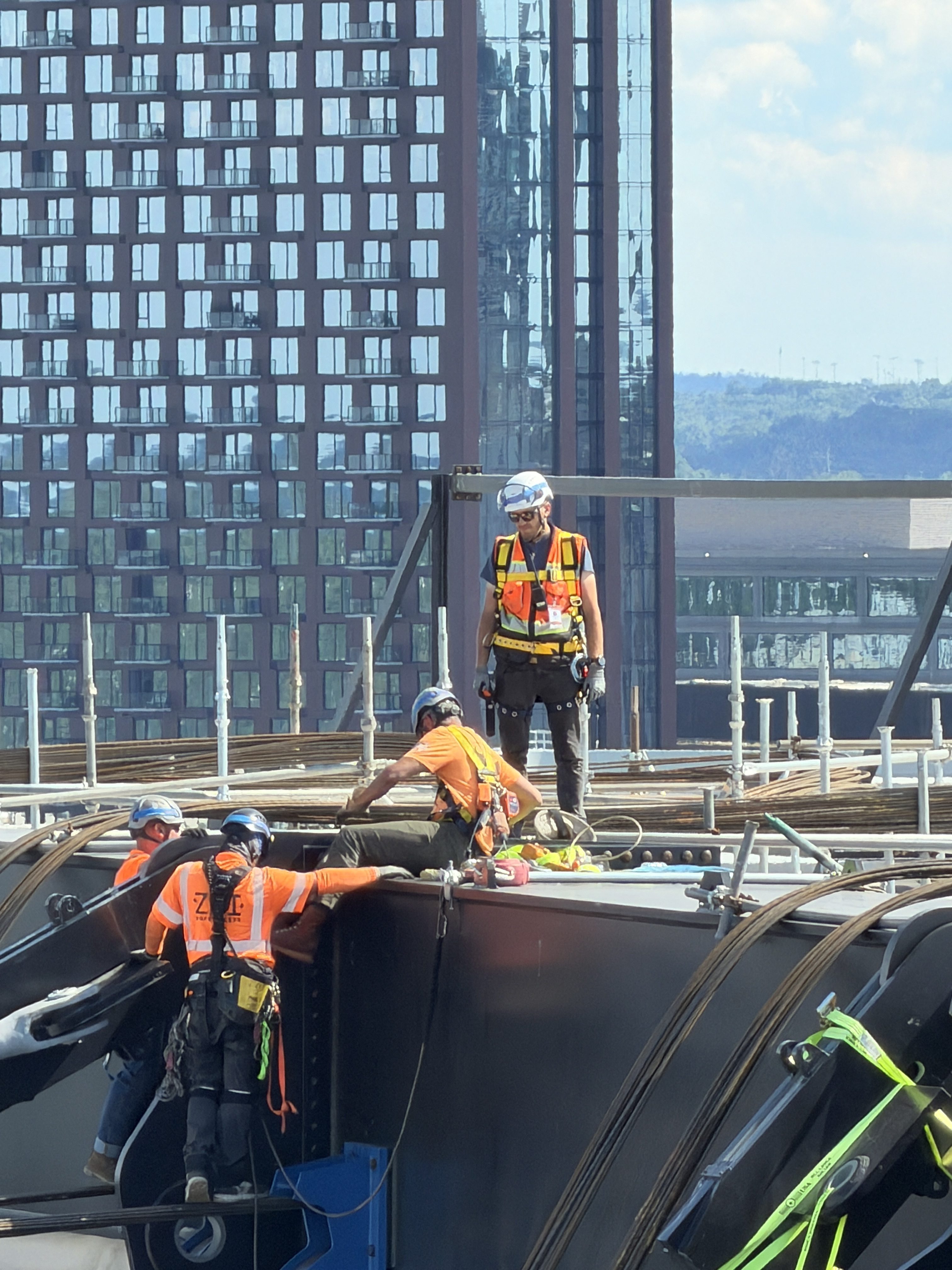
By Joel Willoughby
Construction Safety Advisor | OSHA Authorized Outreach Trainer | OSHA 510 & 500 | 3M Competent Person – Fall Protection
Fall protection remains one of the most critical components of construction safety and continues to be among the most frequently cited standards by OSHA. Despite advances in equipment, training, and planning, serious injuries and fatalities continue to occur due to preventable fall protection failures.
Having worked on large-scale industrial and commercial construction projects, including complex steel erection, manufacturing facilities, and elevated work environments, I have observed several recurring issues that place workers at unnecessary risk. Understanding these failures and addressing them proactively is essential to protecting workers and maintaining compliance.
Failure #1: Improper Anchor Point Selection
One of the most common fall protection failures involves workers connecting their Personal Fall Arrest Systems (PFAS) to anchors that are not designed or rated for fall arrest forces.
OSHA requires anchorages used for attachment of personal fall arrest equipment to be capable of supporting at least 5,000 pounds per employee attached or be designed, installed, and used as part of a complete fall protection system under the supervision of a qualified person.
Reference: 29 CFR 1926.502(d)(15)
Workers often assume that handrails, conduit, cable trays, temporary steel members, or other structural components are suitable anchor points when they may not have been designed for fall arrest loading.
Best Practices:
- Use only approved and designated anchor points.
- Verify anchor ratings before use.
- Have engineered anchor systems reviewed by a qualified person.
- Conduct routine inspections of all anchor devices.
Failure #2: Incorrect Self-Retracting Lifeline (SRL) Usage
Modern construction projects increasingly rely on Self-Retracting Lifelines (SRLs), yet many workers fail to understand their limitations.
A common issue involves using standard SRLs in leading-edge applications where sharp edges may contact the lifeline during a fall. Standard SRLs are not designed for these conditions and may fail under edge-loading scenarios.
Additionally, workers frequently connect SRLs improperly, use incompatible connectors, or create excessive free-fall distances that exceed manufacturer limitations.
Best Practices:
- Follow manufacturer instructions at all times.
- Use Class 2 or leading-edge-rated SRLs when working near unprotected edges.
- Inspect SRLs before each use.
- Remove damaged equipment from service immediately.
- Ensure compatibility between all system components.
Failure #3: Failure to Inspect Equipment Before Use
OSHA requires personal fall protection equipment to be inspected prior to each use for wear, damage, and deterioration.
Reference: 29 CFR 1926.502(d)(21)
Unfortunately, inspections are often rushed or skipped entirely.
Damaged webbing, cut stitching, corrosion, cracked carabiners, bent hardware, missing labels, and damaged energy absorbers are all indicators that equipment may no longer provide adequate protection.
Workers must understand that a damaged harness or lanyard may appear functional while still being incapable of performing during an actual fall event.
Best Practices:
- Conduct documented periodic inspections by a competent person.
- Inspect equipment before every use.
- Remove damaged equipment from service immediately.
- Follow manufacturer replacement schedules.
- Maintain equipment inspection records.
Failure #4: Failure to Properly Address Leading-Edge Hazards
Leading-edge work continues to be one of the most hazardous activities in construction.
Workers installing steel, roofing systems, cable structures, elevated platforms, and other structural components are frequently exposed to changing fall hazards throughout the workday.
As work progresses, fall protection plans often fail to evolve with site conditions. Openings, unprotected edges, and temporary access points can quickly create exposures that were not identified during pre-task planning.
OSHA requires fall protection systems when employees are exposed to falls of six feet or more in construction activities.
Reference: 29 CFR 1926.501(b)(1)
Best Practices:
- Conduct daily pre-task planning.
- Evaluate changing conditions throughout the shift.
- Install guardrails whenever feasible.
- Use engineered horizontal lifeline systems where appropriate.
- Ensure leading-edge-specific equipment is utilized.
Failure #5: Lack of Competent Person Oversight
Even the best fall protection equipment can fail when there is inadequate supervision.
OSHA defines a Competent Person as someone capable of identifying existing and predictable hazards and who has authorization to take prompt corrective measures.
A competent person plays a critical role in:
- Conducting inspections.
- Evaluating fall hazards.
- Verifying equipment suitability.
- Ensuring proper worker training.
- Enforcing compliance with site requirements.
Without active oversight, unsafe behaviors often become normalized, increasing the likelihood of serious incidents.
Best Practices:
- Designate competent persons for all elevated work activities.
- Conduct regular field audits.
- Correct unsafe behaviors immediately.
- Provide ongoing worker training.
- Maintain accountability at all levels of the organization.
Conclusion
Fall protection failures rarely occur because equipment is unavailable. More often, incidents result from poor planning, inadequate supervision, insufficient training, or a failure to follow established procedures.
Successful fall protection programs rely on a combination of proper equipment selection, competent supervision, continuous hazard assessment, and a commitment to safety at every level of an organization.
Construction projects are dynamic environments where conditions can change rapidly. By addressing these common failures before work begins, employers and workers can significantly reduce risk, improve compliance, and most importantly, prevent injuries and fatalities.
Every worker deserves to return home safely at the end of the day. Effective fall protection is not simply a regulatory requirement—it is a responsibility shared by everyone on the jobsite.
Leave a Reply